Superheat and Subcooling
Superheat and subcooling are two important concepts in HVAC and refrigeration. They help explain how refrigerant changes its temperature and state as it moves through an air conditioning system.
For HVAC beginners, understanding these concepts makes it easier to learn how the refrigeration cycle works. For technicians, superheat and subcooling provide useful information about refrigerant conditions and help evaluate system performance.
Before exploring each concept, it is important to understand that refrigerant changes between liquid and vapour as it moves through different components of an HVAC system.
What Is Superheat?
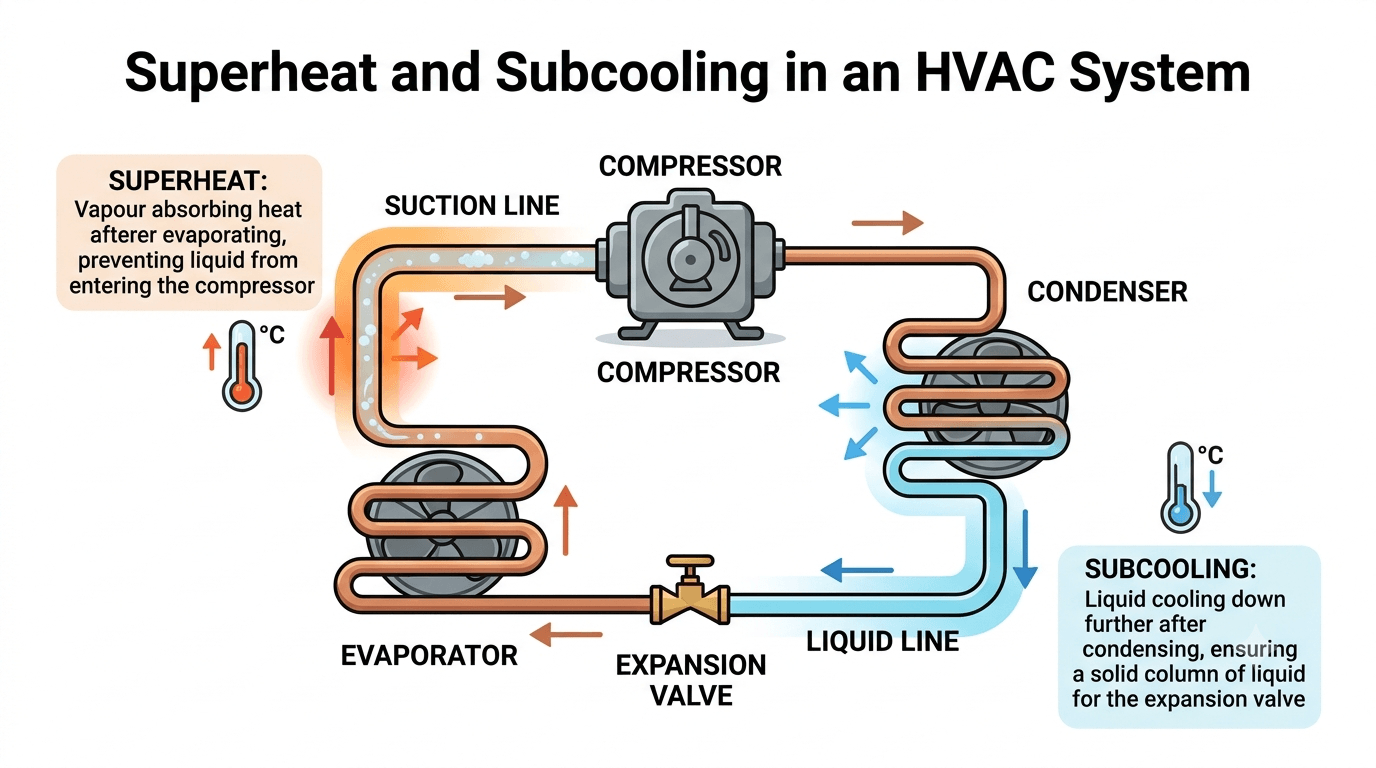
Superheat is the amount by which the temperature of refrigerant vapour rises above its saturation temperature at a given pressure.
In simple terms, when refrigerant absorbs heat inside the evaporator, it changes from liquid into vapour. Once all the liquid has evaporated, the vapour can continue absorbing heat. This additional temperature increase is called superheat.
Superheat helps technicians understand whether refrigerant has completely evaporated before returning to the compressor.
How Does Superheat Work?
The process takes place inside and around the evaporator:
- The expansion device reduces the refrigerant pressure before it enters the evaporator.
- The refrigerant absorbs heat from the surrounding air inside the evaporator.
- As it absorbs heat, the refrigerant changes from liquid into vapour.
- After all the liquid has evaporated, the vapour may absorb additional heat, increasing its temperature.
This additional temperature increase is known as superheat.
Simple Superheat Example
Suppose the refrigerant saturation temperature is 5°C, and the measured suction line temperature is 12°C.
Superheat = Measured Temperature − Saturation Temperature
Superheat = 12°C − 5°C = 7°C
The superheat is 7°C.
This means the refrigerant vapour is 7°C warmer than its saturation temperature at the measured pressure.
What Is Subcooling?
Subcooling is the amount by which liquid refrigerant is cooled below its saturation temperature at a given pressure.
In simple terms, refrigerant releases heat inside the condenser and changes from vapour into liquid. After the refrigerant has completely condensed, it may continue losing additional heat. This further reduction in temperature is called subcooling.
Subcooling helps ensure that liquid refrigerant reaches the expansion device without unwanted vapour formation.
How Does Subcooling Work?
The process takes place inside and around the condenser:
- High-pressure refrigerant vapour enters the condenser from the compressor.
- The condenser releases heat to the surrounding air or water.
- As the refrigerant loses heat, it changes from vapour into liquid.
- The liquid refrigerant may continue losing heat, reducing its temperature below the saturation temperature.
This additional cooling is known as subcooling.
Simple Subcooling Example
Suppose the refrigerant saturation temperature is 40°C, and the measured liquid line temperature is 34°C.
Subcooling = Saturation Temperature − Measured Temperature
Subcooling = 40°C − 34°C = 6°C
The subcooling is 6°C.
This means the liquid refrigerant is 6°C cooler than its saturation temperature at the measured pressure.
Where Are Superheat and Subcooling Measured?
Superheat and subcooling are measured at different points in an HVAC system because they relate to different stages of the refrigeration cycle.
Superheat measurement:
- Usually measured at the evaporator outlet or suction line.
- Requires refrigerant pressure and corresponding saturation temperature.
- Helps evaluate the condition of refrigerant vapour returning towards the compressor.
Subcooling measurement:
- Usually measured at the condenser outlet or liquid line.
- Requires refrigerant pressure and corresponding saturation temperature.
- Helps evaluate the condition of liquid refrigerant travelling towards the expansion device.
Technicians use appropriate pressure gauges, temperature clamps, and refrigerant pressure-temperature information to calculate these values.
Difference Between Superheat and Subcooling
Although both concepts involve temperature differences, they describe different refrigerant conditions.
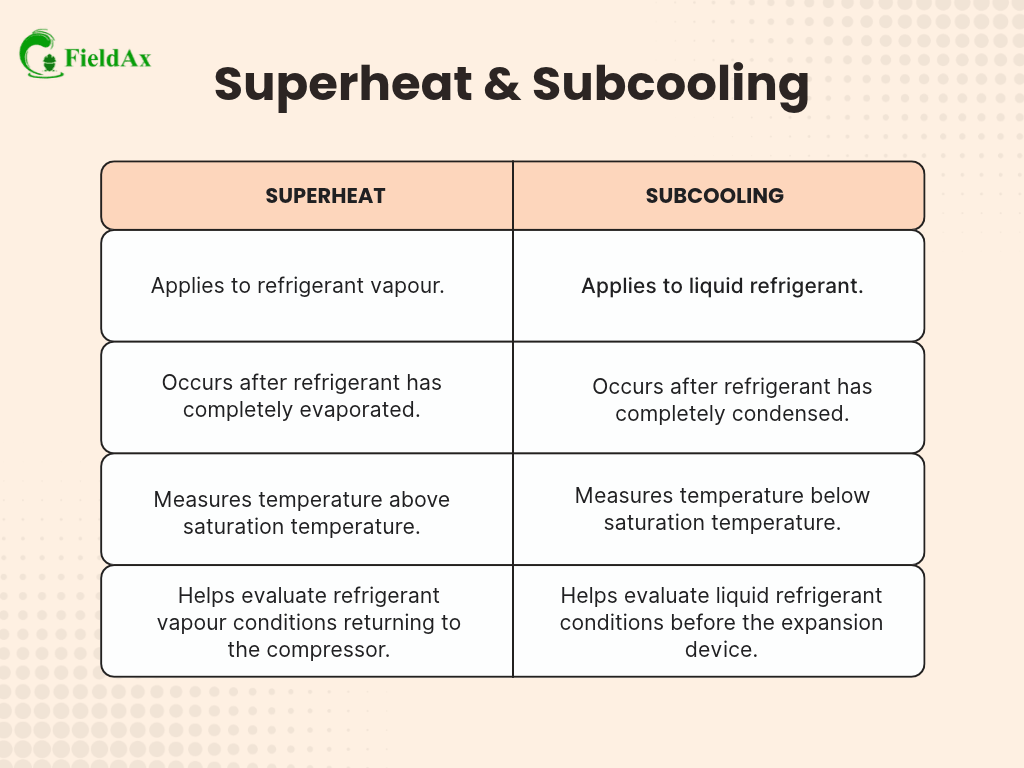
Both measurements provide useful information about how refrigerant moves through the refrigeration cycle.
Why Are Superheat and Subcooling Important?
Superheat and subcooling help HVAC technicians understand the operating conditions of an air conditioning system.
They are useful for several reasons:
- Evaluating Refrigerant Conditions
These measurements help technicians understand whether refrigerant is in the expected vapour or liquid condition at specific points in the system.
- Identifying Possible System Problems
Unusual readings may indicate issues such as incorrect refrigerant charge, restricted refrigerant flow, or other system operating problems.
- Supporting Compressor Protection
Appropriate superheat helps ensure that liquid refrigerant does not return to the compressor through the suction line. Liquid entering a compressor designed for vapour compression can cause serious mechanical damage.
- Evaluating System Performance
Superheat and subcooling readings help technicians assess refrigerant conditions and determine whether the system is operating within the manufacturer’s recommended specifications.
How Do HVAC Technicians Use Superheat and Subcooling?
During HVAC servicing and troubleshooting, technicians measure superheat and subcooling to understand how the refrigeration system is operating.
They generally follow these steps:
- Measure refrigerant pressure at the appropriate location.
- Determine the corresponding saturation temperature using the correct refrigerant pressure-temperature chart or digital tool.
- Measure the refrigerant pipe temperature using a suitable temperature sensor.
- Calculate superheat or subcooling based on the measured values.
- Compare the results with the equipment manufacturer’s recommended specifications.
These readings should always be interpreted alongside other operating conditions, such as indoor and outdoor temperatures, airflow, and system load. A single reading is not enough to identify every refrigeration problem.
Conclusion
Superheat and subcooling play an important role in understanding how an HVAC system manages refrigerant throughout the cooling process. While superheat explains how refrigerant vapour gains additional heat after evaporation, subcooling explains how liquid refrigerant loses additional heat after condensation.
For HVAC technicians, understanding these measurements is essential when evaluating refrigerant conditions and investigating system performance issues. They provide valuable information that can help identify potential problems and guide the troubleshooting process.
Learning these concepts also gives beginners a stronger understanding of the refrigeration cycle and how different HVAC components work together. Ultimately, knowing how to measure and interpret superheat and subcooling helps technicians make better maintenance decisions and support reliable air conditioning system operation.
Our trusted customers