I remember the call on a Friday evening. A site I oversaw looked fine in the reports, but the team was already scrambling. I felt that sinking feeling—how small issues had grown while everyone assumed things were under control.
This guide is my answer to that silence. I connect safety outcomes to real performance, not just checklists. I treat risk as a daily leadership habit, not a binder you open once a year.
I will walk you through a clear program: identification, assessment, mitigation, monitoring, and reporting. Each step is practical and built to fit your crew, your schedule, and your goals. Whether you run mobile tech teams, construction crews, utilities, logistics, or distributed service staff, this matters to your organization and your business.
By the end, you’ll have tools you can lift into your work. I promise an operating system you can use, not just inspiration.

Key Takeaways
- Problems can appear normal until they fail; silent issues compound fast.
- Connect safety to performance rather than compliance alone.
- Practice daily risk management as a leadership habit.
- Follow a five-step program to move from awareness to action.
- These methods apply across many U.S. industries and team types.
- You will leave with practical tools to implement immediately.
What I Mean by Risk in the Field (and Why Definitions Matter)
Definitions shape what we measure; I begin by defining what I track and why it matters.
I call risk the chance a hazard turns into real harm. I judge that chance by two things: likelihood and severity. That simple framework keeps my assessment consistent across sites and crews.
Hazards are sources of harm; risks are the chance those hazards cause damage. Separating the two stops arguments and forces practical focus on outcomes like injury, downtime, regulatory exposure, and customer impact.
Risk vs. hazard: likelihood, severity, and consequences
I measure likelihood on a simple scale and pair it with severity so trade-offs are clear. This makes prioritization repeatable and defensible to leadership and teams.
Why risk can’t be eliminated—but it can be managed and monitored
I do not pretend elimination is possible. Instead, I layer controls, improve reporting, and tighten monitoring so exposures fall below action thresholds.
How distance and low oversight amplify everyday exposure
When I’m remote, small signals vanish. Low oversight increases silent exposure, so my system for identification and communication must be stronger, not weaker.
The Hidden Cost of Waiting for an Incident
Delaying action turns small issues into expensive disruptions. I use the NSC number — $163.9B in U.S. work-injury costs — to show waiting has a price. That total is not abstract; it breaks into real buckets that hit my bottom line.
Wage and productivity losses account for $44.8B. Medical bills add $34.9B. Administrative drag — claims, legal, and back-office work — costs about $61B. Those figures translate to roughly $1,100 per injured worker and about $44,000 for a medically consulted injury.
Those first invoices are rarely the last. I watch insurance premiums climb, contracts evaporate, and retraining take weeks. Long-term effects often dwarf the initial expense and derail schedules, hurting customers and the business.
How losses show up and what I do about them
I track incidents and near misses so patterns don’t hide. Weak reporting and slow management let small events repeat. Proactive controls and clear reporting save time and protect operational continuity.
Why Leaders Don’t See Breakdowns Coming in Daily Operations
I watch steady rhythms mask the little breaks that later cause big headaches. In my experience, daily operations make small problems look normal. When conditions shift, yesterday’s routine can become today’s hazard.
Early warning signals get buried in routine work and shifting conditions
What teams accept as normal becomes the new baseline. That hides weak signals and delays corrective action.
Dashboards often lag reality, so visual reports miss changes happening in the moment.
Frontline teams spot problems first—if I give them a way to speak up
I rely on fast, low-friction reporting from the crew to catch trends early. Quick, non-punitive channels turn observations into fixes instead of future incidents.
When SOPs exist but aren’t followed, risk compounds quietly
SOPs on paper do little unless someone enforces them and follows up. Process drift quietly stacks exposure until something breaks.
Faster communication and clear management follow-through make the paper system live. That strengthens control and lowers the chance of costly incidents.
Where Field Risk Actually Comes From: The Four Operational Risk Buckets
I group what breaks into four clear buckets so my team stops chasing one-off fires. This taxonomy helps me see patterns, assign owners, and prioritize action across the organization.
People
I treat people issues as the most immediate exposure: fatigue, skill gaps, human error, and poor conduct. Training, crew scheduling, and clear expectations cut these exposures quickly.
Process
Process problems act as silent multipliers. Workflow gaps, weak controls, and inconsistent procedures create repeatable failures. I map and standardize processes so fixes scale.
Technology
Technology failures show up as equipment breakdowns, outages, cybersecurity incidents, or bad data. I plan redundancies, maintenance, and simple backups to keep work moving when systems fail.
External Events
Weather, natural disasters, regulatory change, and supply chain shocks can overwhelm controls. Building resilience into schedules, vendors, and contingency plans is central to good risk management.
Organizing threats into these four buckets makes management practical. It stops blame games and lets me assign owners who can act fast.
How I Categorize Field Hazards That Trigger Real-World Incidents
I sort hazards by what actually sends people to the clinic or stops work for days. That makes the analysis useful to crews and leaders, not just a compliance exercise.
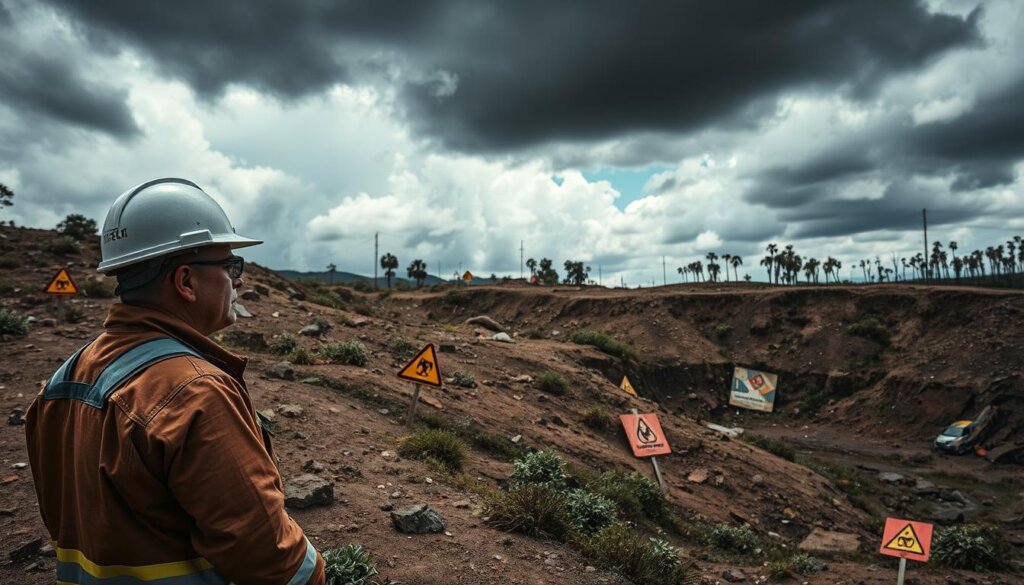
Environmental
Weather swings, wildlife encounters, and hazardous material exposures change conditions fast.
When storms or unexpected wildlife appear, plans can become useless in minutes. I track these hazards so I can adjust schedules and controls before incidents happen.
Movement and equipment
Transport, logistics, and machinery integrity are where many incidents begin.
The road, the load, and the machine create predictable failure points. I map those points to guide maintenance and safe handling procedures.
Human factors
Fatigue, stress, and language or cultural barriers break communication when it matters most.
Training and clear protocols help, but I also design non-punitive reporting and simple signals so team members and employees can coordinate under pressure.
How I use this categorization: I run simple analysis to spot repeating hazard types across sites. Then I target engineering fixes and focused training so safety gains stick—and so my teams know the labels protect them, not blame them.
How I Build a Field Operations Risk Program That Actually Works
I start every robust program at the top, because leaders set the guardrails that make action routine.
Executive sponsorship turns a program from optional paperwork into day-to-day management. I draft a clear risk-appetite statement so supervisors know what leadership will accept and what needs escalation. That clarity speeds time-sensitive decisions and reduces hesitation on critical calls.
Governance that includes the frontline
I build cross-functional governance with true frontline representation. My teams know where processes fail and which controls are practical. Including employees in committees closes the gap between policy and real work.
Culture: reward candor, remove fear
I design non-punitive reporting so people speak up early. When candor is rewarded, reporting increases and problems get fixed before they grow. This cultural shift becomes a practical control that saves time and money.
Fast communication and clear accountability
I connect reporting, communication, and accountability so information flows quickly to owners who can act. That loop makes the program scalable across the organization and keeps managers focused on continuous improvement.
In short: executive backing, a concise appetite statement, governance with frontline voices, and safe reporting turn good ideas into a working program that helps teams and protects employees.
Field Operations Risk Identification That Doesn’t Miss What Matters
I begin by making identification practical: short, repeatable checks that crews will actually do.
Job Hazard Analysis and short site condition reports let me capture hazards without slowing work. I design forms that ask about conditions, present controls, and what changed since the last shift. That keeps reporting actionable, not archival.
Process mapping, workshops, and interviews
I run quick mapping sessions and short interviews to reveal invisible failures—handoffs, unclear approvals, and informal shortcuts. These conversations surface patterns that paperwork misses.
Loss and incident data mining
I mine past incidents to find repeating cues. Small, recurring losses often predict a bigger interruption if left alone. Turning those patterns into corrective actions is where value shows.
External event analysis and scenario thinking
I stress-test plans for extreme weather, vendor shocks, and regulatory change. Scenario thinking forces practical contingencies before a high-impact event arrives.
Tools and a central register keep identification consistent across sites. A single register prevents scattered efforts and turns sightings into accountable tasks I can track and close.
My Approach to Risk Assessment Using Likelihood and Impact
My first step is a simple pair of questions: how likely is this, and how bad could it be? I score likelihood and impact so prioritization is defensible, not emotional.
I use two assessment styles. Qualitative assessments are fast and use expert judgment on a low/med/high or 1–5 scale. I rely on these for time-sensitive on-site decisions.
Quantitative assessments rely on historical data, trends, and models. I reserve them for deeper reviews back at base when I have time and data.
What I measure beyond dollars
Impact includes safety harm, operational disruption, reputational damage, and regulatory exposure. A low-cost fix that ignores safety or compliance can become catastrophic.
Inherent versus residual
I compare inherent scores before controls with residual scores after controls. That shows whether controls actually reduced exposure or only look good on paper.
Time-critical vs. deliberate
On-site assessments must be quick and repeatable. Deliberate assessments use more data and inform prevention plans. Measuring likelihood and impact the same way in both cases gives teams clarity and leadership confidence.
Risk Matrices and Heat Maps I Use to Prioritize the Right Work
A simple map of likelihood and impact turns opinion into action every time. I build a compact matrix so every person on my teams uses the same language when they assess a hazard.
Defining a likelihood scale that teams apply consistently
I use a 1–5 likelihood scale with one-line anchors. Each score has a quick example so crew members and supervisors rate the same conditions.
This consistency makes on-the-spot assessment faster and more defensible during reviews.
Defining impact thresholds that align with leadership expectations
I map impact in dollars, downtime, and harm to people. Then I set thresholds that reflect what leadership will escalate.
That alignment ensures the heat map highlights what the business actually cares about protecting.
Color zoning (red/amber/green) to drive action and resource focus
Red demands immediate action and senior attention. Amber needs planned fixes within a set window. Green means controlled and monitored.
I use heat maps in program reviews to show concentration across regions and asset types. Simple scales, clear definitions, and fast escalation rules keep the matrix usable in the field.
Risk Registers That Turn Field Intelligence Into Accountability
When I log an entry, I force a decision: who owns it and what happens next. A concise register prevents good reports from vanishing when priorities shift. It converts observations into assigned work with a clear review date.

What I capture in every entry
I record the source category, existing controls, current status, owner, and next review date. Each entry answers: who, what, when, and how we’ll measure success.
An example from mobile operations
Example LOG-001: delivery vehicle breakdown during peak hours. Source: technology/equipment. Owner: Fleet Operations Manager. Likelihood: medium (2–3 times/month). Impact: high. Controls: preventive maintenance and backup vehicles. Review: quarterly.
How cadence keeps the register living
I use the register to drive management conversations: what is the residual risk, what next control is required, and who does it by when. Regular reviews and simple monitoring stop drift and surface new failure modes.
The register is my leadership proof point: it shows I treat reported issues as action, not just paperwork, and keeps the program accountable over time.
Risk Mitigation Strategies I Choose When the Field Can’t Wait
When decisions must be fast, I pick mitigation paths that match the moment and the consequence. I do not treat every issue the same; instead, I decide whether to transfer, avoid, accept, or mitigate based on impact and practicality.
Transfer, avoid, accept, or mitigate: choosing the right path
I start by asking: can I move the liability or stop the activity? If yes, I transfer or avoid. If not, I weigh accept versus mitigate.
Accept only when exposure is low and documented. Mitigate when harm or downtime would be meaningful.
Control hierarchy that guides my choices
I prioritize elimination, then substitution, then engineering controls, followed by administrative controls, and PPE last. This keeps my safety strategy grounded in design, not perfect behavior.
Layered controls and testing before scaling
High-severity exposures get multiple layers so one failure doesn’t cause a catastrophe. I pilot controls in real weather, noise, and fatigue conditions before wider rollout.
Training that teaches the why
Training goes beyond checklists. I explain the reason behind each control so teams choose the right action when the script doesn’t fit. I pair short drills with mobile tools and simple templates to make administrative controls usable under pressure.
In practice:I match mitigation to consequence, use the control hierarchy as a rulebook, test in real conditions, and train for judgement—not blind compliance.
Monitoring and Reporting: How I Catch Drift Before It Becomes Failure
I instrument simple signals so I see change before it becomes a story I’ll regret.
Ongoing monitoring to detect change in people, process, systems, and environment
I keep short, repeatable checks that watch people, process, technology, and the site environment. These checks flag deviations early so I can act while fixes are small.
Continuous monitoring keeps the system honest. When training lags or maintenance slips, the data shows the trend before an incident arrives.
Key indicators that act as early warning systems
I build a compact set of key indicators: near-miss frequency, overdue maintenance, and training completion rates. These indicators give me time to prioritize work and allocate resources.
Each indicator links to an owner and a review cadence. Weekly flags get quick fixes; monthly trends trigger deeper analysis and program changes.
Near-miss reporting as a leading indicator, not paperwork
I treat near-miss reports as gifts of time. I encourage fast, non-punitive reporting and show crews the follow-up so the channel stays alive.
Good reporting plus disciplined analysis turns one crew’s near miss into prevention for everyone. That pattern of monitoring and management reduces incidents and keeps performance steady.
Communication That Reaches Non-Desk Teams in the Moment
Clear, immediate lines of communication change how hazards surface and get fixed. I treat communication as a control: if non-desk crews can’t report fast, I can’t manage risk fast. Short channels shorten response time and stop small issues from growing.
Why accessible reporting channels increase hazard reporting
When reporting is easy, reporting rises—and that higher volume means a healthier system, not a worse one. I welcome more reports because they reveal trends I can fix.
Mobile tools and SMS for rapid hazard reporting and urgent updates
I use mobile tools and SMS to reach teams who lack desks. In practice, mobile incident reporting boosted hazard reporting by about 40% in construction settings. These tools give me near-instant inputs and let management push urgent updates when conditions change in minutes.
Closing the loop so frontline workers see action after they report
Trust depends on follow-up. When employees report, I show quick, visible action and document next steps. That feedback makes future reporting repeatable and keeps safety and performance moving together.
Compliance Reality Check for U.S. Field Operations
I keep a close watch on the regulatory landscape so my crews never learn compliance the hard way.
Regulations shape what we do every day. I treat rules as design constraints that protect people and the business. Clear compliance expectations make management decisions faster and reduce surprises at audits.
OSHA: core standards to watch
OSHA covers PPE, hazard communication, confined spaces, fall protection, and machinery safety. I audit these areas first because they show up in most inspections and deliverable reviews.
NFPA: electrical and flammable controls
NFPA 70E and related codes matter for electrical tasks and handling flammable liquids. Mistakes here create major safety and business consequences, so I require strict adherence.
EPA: waste, air, and water requirements
The EPA’s RCRA rules plus the Clean Air and Clean Water Acts influence jobsite handling and permits. I document disposal and emissions to prove compliance and avoid fines.
DOT, ANSI, and MSHA where they apply
DOT HazMat rules govern labeling, packaging, and transport—no improvising. ANSI standards (Z359, Z87.1) and MSHA rules guide specific industry work. I align procedures to the right code for each task.
How I Operationalize Daily Audits, Inspections, and Documentation
Before tools move and engines start, I want a clear snapshot that shows what’s controlled and what isn’t. That snapshot comes from a short pre-shift audit and a program of unscheduled inspections that keep safety real in daily operations.
Pre-shift audits and unscheduled inspections to keep safety real
I run a quick pre-shift audit before the first task so controls are verified in the moment. These checks are brief, binary, and focused on the highest-consequence items.
Unscheduled inspections test actual practice, not policy. Surprise reviews show what crews do under pressure and reveal gaps I can fix quickly.
What field documentation must prove: controls, conditions, actions, and timing
Every report must show four things: the control in place, the conditions observed, the action taken, and the exact time. Time-stamped entries let me defend choices and learn patterns across days and sites.
That proof turns paper or digital notes into management evidence I can use in coaching, audits, and incident analysis.
Using checklists and templates to reduce handwriting errors and missed steps
I use digital checklists and simple templates to cut handwriting errors and missed steps. Mobile tools store data offline and sync when connectivity returns.
When a checklist is completed, the system notifies supervisors so corrective action can start in real time. I then convert inspection findings into short training briefs so each step becomes a coaching moment, not just a completed form.
In short:short pre-shift checks, surprise inspections, clear documentation, and digital tools make safety and reporting part of daily management—not an afterthought.
Conclusion
I design systems that notice small failures long before they become disruptive. My core belief is simple: problems rarely announce themselves, so a practical program must be built to see them early.
Use five clear steps: identification, assessment, mitigation, monitoring, and reporting. Keep likelihood and impact language consistent so teams can prioritize fast and without confusion.
Compliance and regulations become manageable when processes, controls, and documentation tell the truth. Technology, simple tools, and fast communication make reporting real-time and useful.
Start this week: pick one example, log it, assign an owner, set a review, and begin improvement. When members speak up and management acts, the organization grows safer, steadier, and stronger.
See how FieldAx can transform your Field Operations.
Try it today! Book Demo
You are one click away from your customized FieldAx Demo
FAQ
Why do daily operations break before leaders notice?
I see breakdowns happen when routine work masks small deviations. Teams adapt to shortfalls and normalize unsafe shortcuts. Over time those small changes compound until a failure surfaces. I focus on early signals and frontline feedback so problems don’t reach the tipping point.
What do I mean by risk in the field and why does the definition matter?
I define risk as the combination of likelihood and impact that a hazard creates in real-world conditions. That clarity helps me prioritize work, choose controls, and measure effectiveness instead of chasing vague threats or checkbox compliance.
How is risk different from a hazard?
A hazard is a condition or agent with the potential to cause harm. Risk adds the probability of that harm and the consequences. I assess both so I know which hazards demand urgent controls and which need monitoring.
Can risk be eliminated entirely?
No. I don’t expect zero exposure. Instead I manage and monitor risks, reduce likelihood and impact where I can, and build layered controls to keep events within acceptable limits.
How does distance or low oversight increase exposure?
When teams are remote or leaders aren’t present, compliance drifts and local workarounds multiply. I counter that with clear reporting channels, mobile tools, and empowered local ownership so standards stay intact.
What are the real costs when I wait for an incident?
Waiting amplifies direct costs like medical and lost productivity and creates hidden costs in recruiting, overtime, regulatory fines, and damaged reputation. I treat early intervention as a cost-avoidance strategy.
How do workplace injuries translate to business losses?
Injuries create medical bills but also administrative overhead, increased insurance rates, reduced output, and morale decline. I track those cascading effects so leaders see the full financial picture.
Why do longer-term consequences sometimes exceed the initial event?
A single incident can trigger inspections, litigation, regulatory change, or supply disruptions. I plan for knock-on effects by modeling scenarios and building contingency controls ahead of time.
Why don’t leaders spot breakdowns in daily activities?
Leaders often get filtered signals: dashboards that smooth variability and reports that omit near-misses. I push for unfiltered frontline input and key risk indicators so leaders see true operating conditions.
How do I ensure frontline teams speak up?
I create non-punitive reporting, reward candor, and close the feedback loop so workers witness action. When people trust the system, they report hazards early and reliably.
What happens when SOPs exist but aren’t followed?
Unused SOPs become false comfort. I combine training with audits, coaching, and leadership reinforcement so procedures stay practical and applied, not just documented.
Where does operational risk actually come from?
I group sources into four buckets: people (fatigue, skills), process (gaps, weak controls), technology (equipment, systems), and external events (weather, supply shocks). That helps me target mitigation where it matters.
How do I categorize hazards that cause real incidents?
I separate environmental risks, operational risks, and human factors. Each category requires different detection methods and controls, and I tailor my approach accordingly.
What human factors most often trigger problems?
Stress, language barriers, and poor communication top the list. I invest in clear procedures, multilingual tools, and fatigue management to reduce those exposures.
How do I build a risk program that actually works?
I secure executive sponsorship, define appetite, create cross-functional governance with frontline voices, and reward honest reporting. That combination makes the program practical and durable.
What role does executive sponsorship play?
Sponsors set priorities, allocate resources, and model behavior. I use sponsorship to align incentives and keep accountability visible across the organization.
How do I identify the risks that matter in remote sites?
I use job hazard analyses, site condition reporting, process mapping, workshops, and interviews. I also mine past incidents to spot patterns leaders might miss.
When should I use qualitative versus quantitative assessments?
I use qualitative methods for rapid, field-level decisions and quantitative analysis for high-impact or recurring exposures. Both inform prioritization when combined thoughtfully.
How do I weigh nonfinancial impacts like reputation or safety?
I include safety, operational, reputational, and regulatory impacts in assessments and assign thresholds that reflect leadership priorities, not just dollar values.
What’s the difference between inherent and residual risk?
Inherent risk is exposure before controls. Residual risk is what remains after I apply controls. I track both to judge control effectiveness and decide next steps.
How do I use matrices and heat maps to prioritize work?
I define a consistent likelihood scale and impact thresholds, then color-zone risks to drive action. Heat maps make prioritization visible and speed decisions about resource allocation.
What do I capture in a risk register entry?
I record source, existing controls, owner, status, mitigation actions, and review date. That turns observations into accountable tasks rather than forgotten notes.
How do I keep a register current and useful?
I set review cadences, tie entries to owners, and use short updates so the register stays living—one of my operational tools, not an archive.
How do I choose mitigation strategies when time is limited?
I weigh transfer, avoidance, acceptance, or mitigation based on impact and urgency. I prefer layered controls and quick-win measures that stabilize exposure until permanent fixes arrive.
What control hierarchy do I apply first?
I follow elimination, substitution, engineering, administrative, then PPE. I test controls in real conditions before scaling to ensure they work in practice.
How do I monitor risks so issues don’t drift?
I track key risk indicators, near-miss reports, and ongoing monitoring across people, processes, systems, and environment. Those signals let me detect change before it becomes failure.
Why is near-miss reporting important?
Near-misses reveal hazards before harm occurs. I treat them as leading indicators and act quickly to remove causes rather than waiting for incidents to teach lessons.
How do I communicate with non-desk teams effectively?
I use mobile tools, SMS alerts, and simple reporting channels that work in noisy, moving environments. I also ensure follow-up so workers see the results of reporting.
What compliance standards matter most for U.S. field work?
OSHA standards for PPE and hazards, NFPA 70E for electrical risks, EPA rules for hazardous materials, DOT hazmat transport rules, and industry standards like ANSI and MSHA all shape my control choices.
How do I operationalize audits and inspections daily?
I run pre-shift checks, random inspections, and clear documentation that proves controls, conditions, and actions. Checklists and templates reduce errors and make findings actionable.
How do I train teams so they follow procedures willingly?
I explain the “why” behind controls, use hands-on practice, and connect training to real examples. When people understand purpose and outcome, adherence improves.
Author Bio

Co-Founder & CMO at Merfantz Technologies Pvt Ltd | Marketing Manager for FieldAx Field Service Software | Salesforce All-Star Ranger and Community Contributor | Salesforce Content Creation for Knowledge Sharing