
I remember the first time a glossy demo promised overnight change. I signed the contract with hope, then watched teams resist and data fall apart. That felt like a punch to the gut.
This guide is the playbook I wish I had before I spent time and budget on assumptions. I’m sharing a repeatable approach that protects schedules, preserves morale, and delivers measurable gains.
Too often leaders treat a roll as “just a tool.” When adoption lags, even great systems give bad data. Bad data destroys trust, reporting, and daily decisions.
Read on and you’ll get a clear roadmap: a business-change mindset, a hard pre-launch check, vendor selection tactics, focused planning, practical training, and go-live discipline. My aim is simple: tie every step back to real value efficiency, productivity, and better customer outcomes.

Key Takeaways
- Start with people, not features—adoption drives value.
- Use a reality check before launch to protect time and budget.
- Choose vendors by fit and outcomes, not by demos.
- Plan training and communications with empathy and clarity.
- Measure adoption and data quality as primary success metrics.
Why I Treat Field Software as a Business Change, Not Just a Tool
I start every deployment by reframing technology as a change in how people work. That mindset keeps the focus on outcomes and keeps the effort tied to real business goals.
How “extra monitoring” fears quietly kill adoption and data quality
When reps feel watched they resist. Resistance shows up as skipped entries, backfilled logs, and poor data quality. That kills trust faster than any technical bug.
What I say internally to connect the change to real business goals
I lead with purpose: this automation helps reduce manual work and speeds issue resolution. I explain the clear benefits—fewer updates, better priorities, and faster customer responses.
I ask managers to model the right behavior, using dashboards for coaching, not punishment. That shift in management creates honest entry and supports healthy adoption.
When teams see that the change helps them do great work, organizations and companies win. I keep the message simple, repeatable, and tied to metrics I can defend at any meeting.
My Pre-Rollout Reality Check: Needs, Workflows, and Ground Truth From the Field
Before I touch configuration, I run a reality check that proves what teams actually need. I interview technicians, dispatch, and operations leaders to find where the current process breaks and where rework happens.
Running a needs assessment that surfaces operational gaps and technician pain points
I translate pain into clear workflows—what must happen, in what order—so I avoid automating chaos. That makes the user experience repeatable under pressure and reduces mistakes.
Designing for real conditions like limited time, travel, and poor connectivity
Tools must support quick updates and offline use. I design steps for short on-site time, travel between jobs, and interruptions so the team can capture fast, reliable data.
Choosing data you’ll actually use so forms don’t become busywork
I tie every field to a decision, KPI, or compliance need. If we won’t use it, we don’t collect it. Then I validate ground truth by testing forms in basements, parking lots, and rural areas so updates survive weak signal.

Result: fewer fields, clearer workflows, and higher-quality data that protect efficiency and morale from day one.
How I Pick Software and a Vendor Without Getting Sold a Demo
I choose vendors by the loop they can close, not the slides they can show. I expect a trial that proves the work end-to-end and exposes gaps before contracts start.
Functionality, scalability, and user experience I won’t compromise on
My scorecard tests core functionality against real workflows. I check that the app does the job my team needs, that it scales as headcount and data grow, and that the user experience is fast for on-the-go work.
Integration with CRM/ERP and existing systems to avoid duplicate work
Integration is non-negotiable. I map what must sync with crm/erp and other systems so nobody retypes records and errors don’t multiply.
In trials I create a job, dispatch it, complete it offline, sync, and confirm invoices and reports arrive in the right system without hacks.
What vendor support needs to look like after go-live
I ask direct questions about implementation approach, migration help, admin training, and SLA timelines. Good vendor support means responsive ticketing, a living knowledge base, a customer success motion, and upgrade guidance that protects service.
Bottom line: tools alone don’t deliver outcomes. The right software plus a reliable partner and disciplined delivery create lasting value and protect your resources.
How I Plan a Field Software Rollout That Stays on Time, on Budget, and on Mission
I treat planning like mission control: clear goals, tight guardrails, and fast feedback so the implementation becomes predictable and people stay confident.
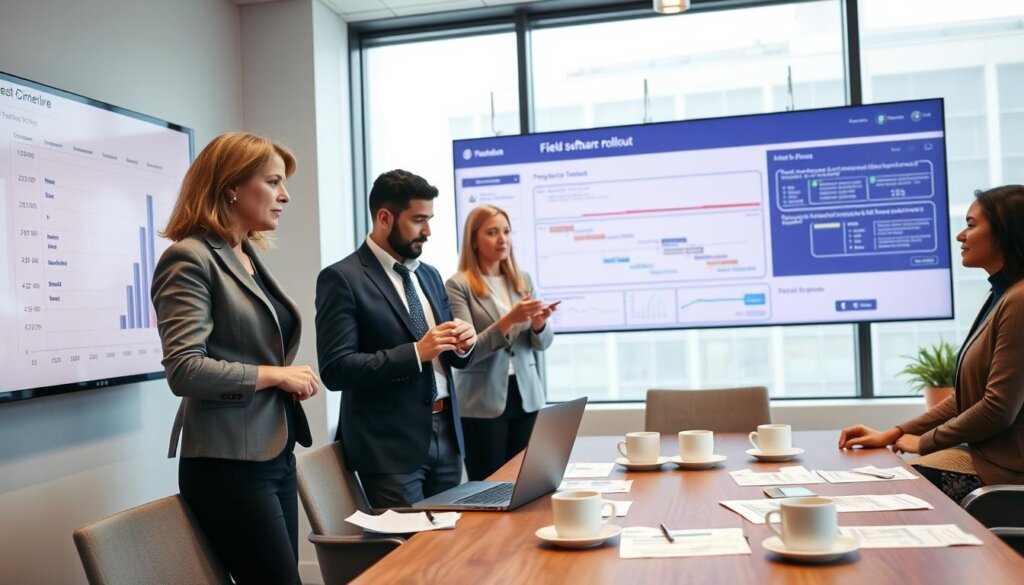
Setting SMART goals and KPIs teams can rally around
I set specific, measurable targets before implementation—faster response times, higher first-time fix rates, or better reporting timeliness.
Then I pick KPIs that frontline teams can actually influence and baseline current performance so success is provable, not just a feeling.
Building a cross-functional implementation team
I form a team with operations, IT, finance, service, and dispatch. Each role has clear decision rights to avoid approval logjams.
This management structure speeds choices and aligns stakeholders on the same goals.
Budget and timeline guardrails
Because companies often underestimate scope, I budget for configuration, migration, testing, training, and stabilization—not just licenses.
I use phased milestones, contingency buffers, and weekly reviews to stop scope creep and keep the project on time and on budget.
Phased approach for quick wins and steady productivity
I launch one high-impact workflow first—earn quick wins, stabilize adoption, then expand. That keeps teams focused and protects morale.
On mission means every phase maps back to the goals, the KPIs, and the people doing the work—not a vendor feature list.
Training and Communication: The Part Vendors Underestimate and Teams Remember
Training wins are the quiet ROI most vendors never price into their demos. I budget for training early because Gartner’s 40–60% estimate for implementation, training, and upgrades matches what I see in real programs.
I design training that respects the field: short, hands-on sessions, real-job practice, and online tutorials so learning fits work rhythms. Managers get parallel coaching so dashboards become coaching tools, not mystery gadgets.
What I include and why it matters
I provide recorded walkthroughs, quick-reference guides, and clear support channels so teams regain momentum fast when they hit a snag. Giving people access to practical resources reduces downtime and builds trust.
I keep communication steady: I repeat the why, share progress against goals, celebrate wins, and call out friction early. That consistent communication prevents fatigue and silent resistance.
Bottom line: connect features to fewer duplicate steps and faster updates so the tools feel like leverage. When technicians and managers see real value, adoption and data quality follow.
Go-Live Without Chaos: Testing, Pilots, and a Checklist I Refuse to Skip
A single messy launch can undo months of preparation, so I build tests that prove the work in real time. That philosophy forces measurable checks before any big change hits crews and customers.
User Acceptance Testing for real workflows
I run UAT with technicians and dispatch using real scheduling, job completion, invoicing, and reporting scenarios. This reveals where the process breaks and where training or config must change.
Pilots that mimic pressure
I pilot with a small set of crews on real routes. The goal is validation: usability, data flow, and systems reliability under time and travel constraints.
My checklist covers logins, permissions, offline sync, notifications, integrations, reporting outputs, and escalation paths. Nothing is left to discovery on day one.
After launch I track adoption signals (logins and completion rates), data quality checks, and early performance trends. I gather feedback fast, turn insights into configuration or training changes, and keep leaders accountable so the implementation becomes a successful implementation in practice.
Conclusion
Conclusion
I judge a project by steady gains in day-to-day performance, not by launch-day fanfare. I lead people first and link changes to clear goals so the work delivers lasting value.
I follow a repeatable path: clarify needs, design real-world workflows, choose software and systems that integrate, plan with guardrails, train deeply, test thoroughly, and manage adoption with discipline. That approach improves efficiency, productivity, and customer experience while protecting operations and service quality.
Strong management behavior is the multiplier: coaching with insights and KPIs creates better updates, trust, and measurable outcomes. I set targets, collect feedback, and keep training and support in place so the effort becomes continuous improvement, not a one-time event.
See how FieldAx can transform your Field Operations.
Try it today! Book Demo
You are one click away from your customized FieldAx Demo
FAQ
What most vendors don’t tell you about field software rollouts?
I’ve learned that many vendors focus on features and gloss over the organizational change required. A successful launch demands clear processes, training, and measurable KPIs. If you treat the project as a transformation in how teams work — not just a new tool — you avoid wasted time, poor data quality, and disappointed stakeholders.
Why do I treat this as a business change, not just a tool?
When I position it as a business change, people see how their daily work connects to company goals. That mindset drives adoption, improves data accuracy, and creates measurable value. It also helps me align operations, IT, finance, and service around shared success metrics instead of isolated feature checklists.
How do “extra monitoring” fears kill adoption and data quality?
I’ve seen teams push back when they feel surveilled. That resistance leads to workarounds and bad data. I counter that by setting transparent objectives, showing how metrics help coaching and resource planning, and limiting visible monitoring to what’s necessary for safety and performance improvement.
What do I say internally to connect the rollout to real business goals?
I use concrete examples: faster invoicing, fewer repeat visits, improved first-time fix rates, and better customer satisfaction. Framing the change around those outcomes helps technicians and managers understand why the shift matters to revenue, workload, and customer experience.
How do I run a needs assessment that surfaces operational gaps and technician pain points?
I combine ride-alongs, shadowing, and short surveys with leaders and technicians. I map workflows, capture bottlenecks, and prioritize pain points that block productivity. The goal is to build requirements that reflect real work conditions, not hypothetical best cases.
How do I design for real conditions like limited time, travel, and poor connectivity?
I insist on lightweight forms, offline capabilities, and minimal clicks for core tasks. I prototype with actual users and test during typical travel windows. The result is a toolset that respects technicians’ schedules and reduces entry friction.
How do I choose data you’ll actually use so forms don’t become busywork?
I limit required fields to what informs decisions and reporting. I map each data point to a decision or KPI before it becomes mandatory. That keeps techs focused and ensures managers get actionable insights instead of noise.
What functionality, scalability, and user experience criteria do I refuse to compromise on?
I require intuitive interfaces, offline support, role-based access, and APIs for integrations. Scalability matters for peak seasons and geographic growth. If a product slows workflows or blocks integrations, it’s a no-go for me.
How do I avoid getting sold on a demo and pick the right vendor?
I ask for references with similar operations, request proof of integrations with existing CRM or ERP systems, and run a short pilot with real users. Demos can be polished; pilots reveal whether the vendor supports real-world adoption and long-term value.
What must vendor support look like after go-live?
I expect dedicated implementation resources, ongoing training, clear SLAs, and a roadmap for enhancements. Support should shift from ticketing to partnership: proactive optimization, data reviews, and help tailoring workflows as needs evolve.
How do I set SMART goals and success metrics that people rally around?
I define specific targets like reducing repeat visits by X% or cutting paperwork time by Y minutes per job. I make those goals measurable, assign owners, set realistic timelines, and tie progress to coaching and recognition so teams stay motivated.
How do I build a cross-functional implementation team?
I bring together operations, IT, finance, service managers, and dispatch early. Each role contributes requirements, approvals, and change management. That alignment prevents surprises and keeps the rollout on track and on budget.
What budgeting and timeline guardrails do I use to avoid scope creep?
I separate core MVP features from nice-to-haves, set contingency reserves, and define fixed phases with acceptance criteria. I review scope at each gate and push nonessential items to later phases to protect budget and deadlines.
What is my phased rollout approach for quick wins without overwhelming teams?
I start with a small pilot focused on high-impact workflows, capture wins and feedback, then expand in waves. This builds confidence, demonstrates value early, and reduces the risk of system-wide disruption.
Why invest in training early, knowing upgrades can be a major cost?
Early training reduces errors, speeds adoption, and cuts long-term support costs. I build training into the budget and plan for refresher sessions tied to upgrades so teams stay competent and comfortable.
How do I train managers alongside technicians so dashboards turn into coaching?
I run parallel sessions: practical hands-on training for technicians and analytical sessions for managers that focus on interpreting KPIs and coaching techniques. When managers know what to look for, data becomes a tool for improvement, not punishment.
How do I keep communication consistent so the “why” stays louder than change fatigue?
I use short, regular updates, success stories from pilots, and clear channels for feedback. Celebrating small wins keeps momentum and reminds teams how the change improves their daily work and customer experience.
What does my UAT (User Acceptance Testing) focus on?
I design UAT around real workflows: scheduling, invoicing, reporting, and handoffs. Test scripts mimic true conditions so we validate not just features but data flow, integrations, and usability before broader deployment.
How do I run pilot runs to validate usability, data flow, and adoption?
I run pilots in representative territories, monitor data quality and process metrics, collect direct feedback, and iterate quickly. I treat pilots as learning loops that refine configuration, training, and change management before scale.